Token Pricing Economics: Will LLM Providers Keep Their Pricing Power?
Benedict Evans argues that today's token prices reflect a temporary supply crunch and that every visible market dynamic points toward frontier models becoming commodity infrastructure, which means founders should plan for falling LLM costs rather than assume today's rate cards.
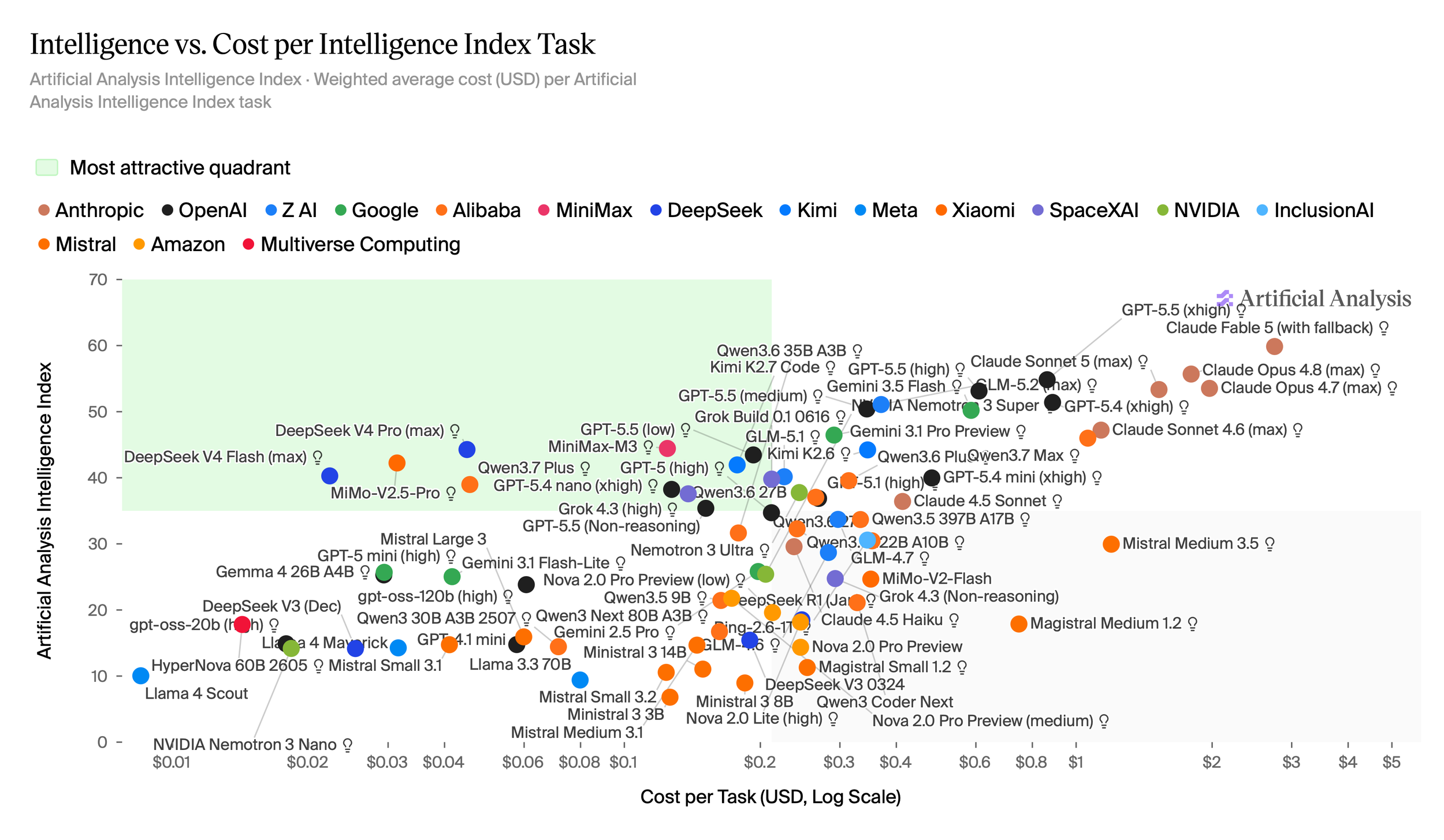
Key takeaways
- Evans sees only two certainties about token prices: we are in a supply crunch, and it is unstable.
- Inference is widely reported to run at 40-50% gross margins today, before counting the cost of training the next models, which currently exceeds revenue.
- His four open questions: who pays to be at the frontier, does the frontier keep moving, does competition stay fierce, and how much value does the model itself capture.
- The history rhyme: mobile data became a trillion-dollar industry with $200B of annual capex, and the stocks went nowhere. Value moved up the stack.
- For app-layer founders the actionable version is simple: treat tokens as a variable cost that will probably fall, and decide today what you will do with the margin when it does.
What do we actually know about token prices?
Very little, and Evans is disciplined about saying so. On supply, a trillion dollars or more of data center capex is coming, and inference efficiency keeps improving. On demand, the current crunch has been driven by product-market fit in essentially one use case, software development, which is a small field next to a consumer use case with hundreds of millions of daily users. Reported inference gross margins of 40-50% include server depreciation but exclude training runs that currently cost more than revenue.
So the question is not what tokens cost this quarter. It is whether foundation models end up with durable pricing power, or become low-margin commodity infrastructure. Evans' read: every dynamic visible today points to the latter.
Why does commodity infrastructure look like the default?
Four questions decide it. How many use cases actually need the expensive frontier, and how many are served by smaller, cheaper, good-enough models? Does the frontier keep moving fast enough to stay ahead of falling prices? Does competition stay fierce, given that every lab uses mostly the same science and the same data and gets mostly the same results? And how much of the value lands in the model itself, versus the tooling, data and go-to-market wrapped around it?
At one extreme, a couple of giant minds run half of everything and name their price. At the other, LLMs look like databases: millions of them, some big, some small, with the value in what is built on top. Every SaaS company is a database wrapper, and it was never the database that captured the value. Evans' point is that any path to durable pricing power requires something to change that nobody can see yet.
What do the historical analogies say?
Analogies do not predict, but they prove the range of outcomes. Mobile data usage rose by orders of magnitude over 20 years and became an industry with a trillion dollars in annual revenue and $200B in capex, yet carrier stocks went nowhere, because the value was captured up the stack by apps. Semiconductors went the other way on concentration: the frontier got so expensive that only TSMC remains, yet even TSMC's $53B in net income is less than half of Apple's. Being indispensable and being the one who captures the value are different jobs.
What should a founder do with this?
Tokens sit in your P&L as a continuous variable cost, closer to COGS than to a software license. Three concrete moves follow.
First, model per-task costs now. Know what each user action costs you across providers, because that is the number that moves when this market shakes out.
Second, build a price-drop scenario. If your inference cost fell by half, would you cut prices, expand usage limits, or bank the margin? Deciding in advance beats deciding under competitive pressure. As an illustration, say an AI feature costs you $0.40 per active user per month at today's rates. At half the token price it costs $0.20, and the only question is whose pocket the other $0.20 lands in.
Third, price on value, not cost-plus. This is the uncomfortable part the essay implies: if model prices fall for you, they fall for your competitors the same day. Cost declines get competed away at the app layer unless your pricing metric captures value. Pick a value metric now, while cost still looks like the constraint. You can model provider mixes, per-task costs and price-drop scenarios in Calcaas and see which of your tiers survives each future.
The market will decide whether the labs become utilities. Your margin should not have to wait for the answer.
Frequently asked questions
Are LLM providers profitable on inference?
Inference is reported to run at roughly 40-50% gross margins, including depreciation of the associated servers. But training the next models currently costs more than revenue, so the businesses as a whole remain far from profitable.
Will token prices keep falling?
Evans argues today's prices reflect a temporary supply crunch, with massive data center capex and steady efficiency gains pushing the other way. Nothing is guaranteed, but every visible dynamic points toward cheaper tokens over time.
What does commoditization mean for AI startups?
If models become commodity infrastructure, value moves to the application layer, as it did in mobile. Falling model costs help every competitor equally, so durable margins come from value-based pricing and product depth rather than from cheaper tokens.
How should founders model token costs?
Treat tokens as a continuous variable cost per user action, like COGS, rather than a fixed software expense. Track per-task cost across providers and stress-test your pricing against scenarios where inference prices fall sharply. Note: place this JSON-LD in a <script type="application/ld+json"> tag in the page head.
More from the blog
 LLM Economics
Jevons Paradox in AI: Why Cheaper Tokens Mean Bigger Bills
Jevons paradox in AI means that when tokens get cheaper, people use so many more that total spend rises. If price per task halves from $0.10 to $0.05, volume must double just to hold spend flat, and a tripling lifts spend 50 percent.
 LLM Economics
OpenRouter Pricing: What a Gateway Really Costs
OpenRouter pricing is the underlying model rate plus whatever platform fee the gateway adds, so the real question is net cost. Say a 5 percent fee on $10,000 of monthly tokens adds $500, and routing 15 percent of spend to cheaper models saves $1,500, a net gain of $1,000.
 LLM Economics
MoE Cost per Token: Why Active Parameters Rule
For a mixture-of-experts model, compute per token follows active parameters, while the GPUs you must rent follow total parameters. A model with 40B active out of 400B total can be cheaper per token than a dense 70B at high utilization, and more expensive when traffic is thin.
Pricing math, in your inbox.
One short note a week on AI pricing, token economics, and margin. No spam, unsubscribe anytime.