Pricing Strategy
Frameworks for pricing AI products without quietly leaving margin on the table.
 Pricing Strategy
Why Hasn't SaaS Pricing Raced to the Bottom? The Uncomfortable Answer for Founders
It's not because competition is weak, it's because price is rarely the thing customers are actually optimizing for, and founders who compete on price alone usually lose anyway.
 Pricing Strategy
Is Subscription Pricing Still Right for Your SaaS, or Should You Switch to Usage-Based?
Neither wins by default: the right model depends on whether your costs scale with usage, and for AI features, they almost always do.
 Pricing Strategy
Token Volume Is Up 25x and Mid-Tier Models Do 90% of the Job. Your Pricing Has to Move.
Tom's Hardware reports token volume exploding 25-fold while mid-tier models deliver roughly 90% of flagship capability at one-sixth the cost, which means the default choice of flagship-everything is now a margin decision rather than a quality one.
 Pricing Strategy
A Frontier Model Launch Is a Repricing Event: A Six-Step Checklist for Founders
When a provider ships a new flagship at a new rate, your cost of goods sold changes before your pricing page does, so treat launch day as a margin review rather than a feature announcement.
 Pricing Strategy
Meta Just Put a Price on Your Prompts, and It Is Not 95%
Meta's Muse Spark contributor tier cuts input tokens by 92% and output tokens by 95.3%, so the discount you actually capture depends entirely on your input to output ratio.
 Pricing Strategy
OpenAI Is Selling Ads on ChatGPT's Free Tier: What It Means for Your AI Pricing Model
OpenAI has started showing ads to ChatGPT's Free and Go users in India, turning ad revenue into a third monetization lever alongside subscriptions and API usage, a move most AI builders can't copy but should still learn from.
 Pricing Strategy
Airtable Sold at 2.7x ARR. Here Is What Seat-Based Pricing Is Worth Now
Airtable sold its core platform to Bending Spoons for $1.285 billion, roughly 2.7 times its $480 million in ARR, while still growing more than 20% a year, which hands the market a public clearing price for seat-based software in the agent era.
 Pricing Strategy
Credit Pricing and Margin Guardrails: What Leonardo.ai's Token Model Teaches AI Founders
A credit layer works when it absorbs variable compute cost, and it only stays safe when your unlimited tiers cover models you actually own.
 Pricing Strategy
ChatGPT Business Premium Seats: 5x the Price for 5x the Usage, and Why That Is Unusual
OpenAI priced its new Premium seat at $125 per user per month against $25 for Standard, exactly 5x for exactly 5x the usage, which is rarer in SaaS pricing than it sounds.
 Pricing Strategy
How to Price AI Products: Founder-Owned Pricing, Surprise Bills, and Inference Margins
The short answer from operators at Aiven and Stripe: a founder should own pricing personally, treat it as an iterative computation rather than a one-time decision, and only pass inference through at cost when inference is not the value you sell.
 Pricing Strategy
What Cursor's $7 India Plan Teaches AI SaaS Founders About Geographic Pricing
Cursor just launched a roughly $7-a-month India-only plan, a third of its $20 Pro price, and the trick that makes it sustainable is routing those users to its own cheaper models instead of frontier third-party ones.
 Pricing Strategy
Runway's Pivot From 'Best Model' to 'Best Router' Is a Pricing Story
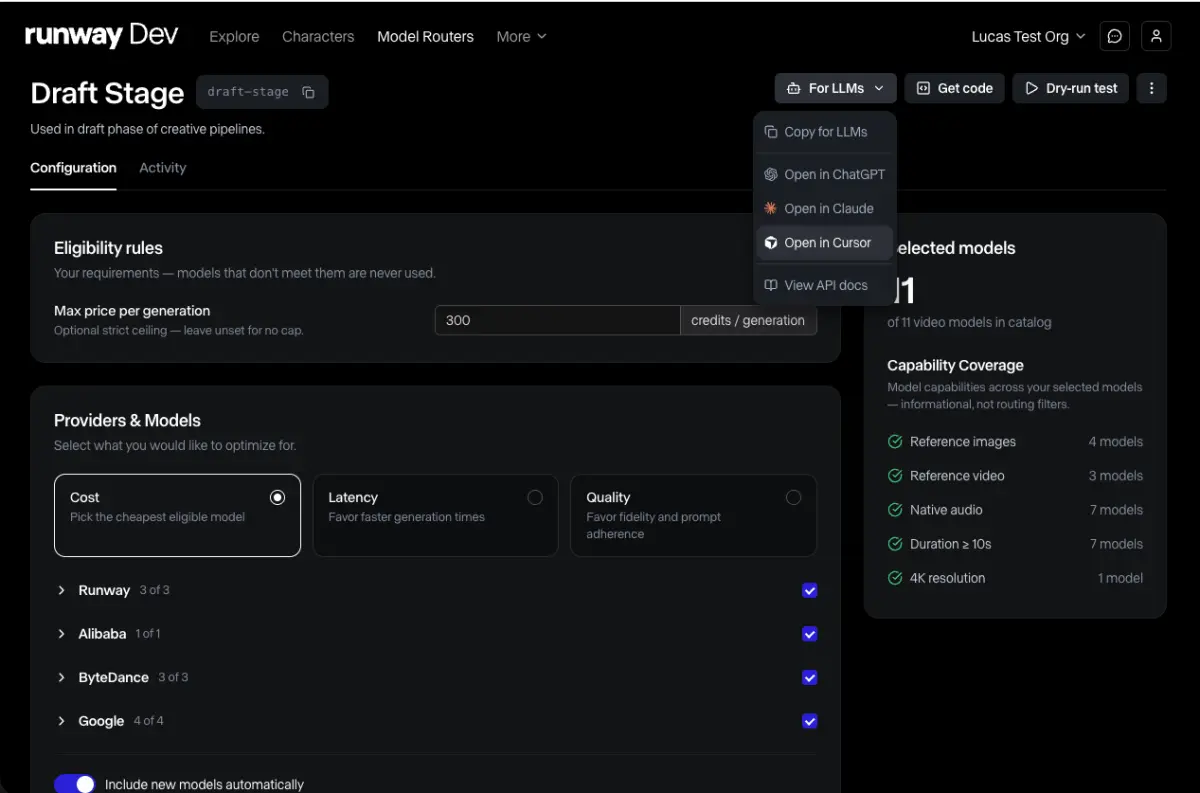
Runway just launched a router that picks the cheapest or best generative-media model per request, weeks after swapping its unlimited plans for token-based pricing, a two-part playbook worth studying if your own product depends on someone else's model.
Pricing math, in your inbox.
One short note a week on AI pricing, token economics, and margin. No spam, unsubscribe anytime.