LLM Prices Fell 13x in Four Months: What That Actually Does to Your AI Margins
Frontier-level intelligence now costs roughly one-thirteenth what it did four months ago, but a 13x cut in list price only becomes a 13x cut in your COGS if you re-route workloads and hold token consumption flat.
Key takeaways
- OpenAI cut GPT-5.6 Luna by 80% to $0.20 per 1M input tokens and $1.20 per 1M output, and Terra by 20% to $2 / $12.
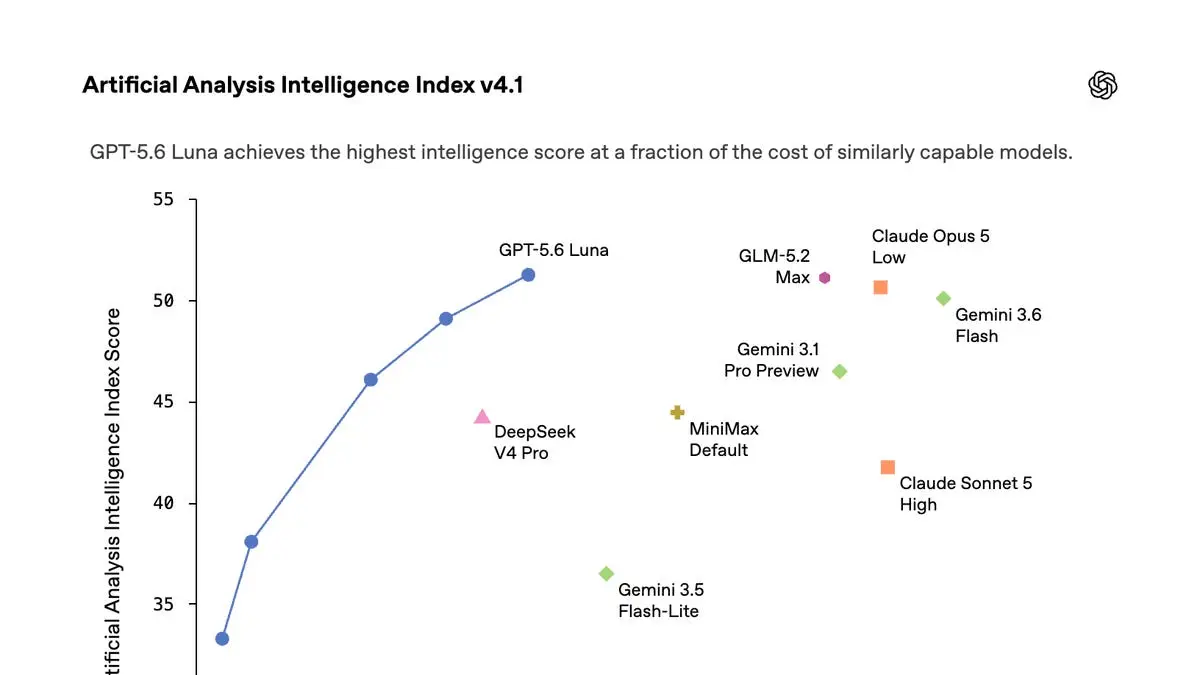
- A March flagship that cost $2.50 / $15 scored the same on Artificial Analysis' index as the July small tier at $0.20 / $1.20, roughly 13x cheaper for the same measured intelligence.
- Price cuts land on a model tier, not on your bill. Blended COGS moves only as far as your workload mix lets it.
- Agentic products grow tokens per task faster than providers cut prices, which is how a real price cut turns into a flat gross margin.
- Deflating input costs are an argument against cost-plus pricing and in favour of value or outcome pricing.
What actually changed in the July 2026 price cuts?
Three things, announced together. GPT-5.6 Luna dropped 80%, to $0.20 per million input tokens and $1.20 per million output. GPT-5.6 Terra dropped 20%, to $2 / $12. And Sol gained a Fast mode in the API: up to 2.5x the speed for 2x the price, with no change in stated intelligence.
The stated cause is serving efficiency rather than a margin sacrifice. OpenAI describes autonomous kernel rewrites that cut end-to-end serving cost by about 20%, an improved draft model for speculative decoding worth over 15% in token-generation efficiency, and KV cache and batching work tuned per workload. On top of that sits harness-level work: capping tool outputs at 10,000 tokens by default and treating model-visible history as append-only so the prompt prefix stays cacheable.
That last detail matters more to builders than the headline. Prompt-prefix stability is something you control in your own app.
Why is "13x cheaper" the number that matters?
Because it holds quality constant. The March flagship, run at high reasoning effort, scored 51 on Artificial Analysis' index at $2.50 / $15. The July small tier sits at the same 51 at $0.20 / $1.20. Same measured capability, about one-thirteenth the token price, roughly four months apart.
One caveat worth stating plainly: public benchmarks get optimised against over time, so treat 13x as directional rather than exact. The direction has held for two years running. An earlier version of this same chart showed GPT-4-level intelligence falling about 1000x over 18 months.
Does a 13x price cut mean 13x better margins?
No, and this is where most founders misread the news. Three things get in the way.
Mix. The cut applies to a tier. If most of your spend sits on the model you did not downgrade, your blended cost barely moves. Say you spend $10,000 a month on inference and 15% of it runs on the small tier. An 80% cut there saves $1,200. That is a 12% reduction, not an 80% one.
Token growth. Agentic products consume more tokens per completed task every quarter: more tool calls, longer context, more retries, more verification passes. If your average task went from 4 model calls to 12 over the same period, the price cut is already spent.
Competition. If your competitors reprice on the new floor, the saving leaves as a price cut rather than arriving as margin. Falling COGS is only a margin event if you choose to keep it.
How should you respond to a price cut?
Re-benchmark on your own evaluation set, not the vendor's. A tier that matches a flagship on a public index may still fail on your specific extraction, tone, or long-horizon task.
Route by task rather than by default. Classification, summarisation, and routing rarely need your best model. Reserve the expensive tier for the small share of calls that measurably fail without it.
Measure cost per successful task, not cost per token. A cheap model that needs two retries is not cheap.
Structure prompts to be cache-friendly. Keep system instructions and history append-only so the prefix stays stable, and cap what tools are allowed to dump into context.
What does falling token cost mean for your pricing model?
Here is the part the price-cut coverage tends to skip. If your input cost falls 13x in four months and you price cost-plus, you have signed up to re-price downward every quarter, forever, while your competitors do the same. That is a race with no finish line.
Deflating COGS is structurally an argument for value-based or outcome-based pricing. Charge for the resolved ticket, the reconciled invoice, the qualified lead. When the model line drops 80%, that shows up as gross margin instead of as a mandatory discount. Seat pricing behaves similarly: the same seat quietly gets cheaper to serve every quarter.
The founders who benefit most from this deflation are the ones whose price was never anchored to the token in the first place.
Takeaway: treat every provider price cut as a routing and pricing decision, not as a windfall that arrives on its own.
If you want to see what a tier switch does to your blended cost and gross margin before you ship it, you can model both scenarios side by side in Calcaas.
Frequently asked questions
How much did GPT-5.6 pricing drop in July 2026?
GPT-5.6 Luna dropped 80%, to $0.20 per million input tokens and $1.20 per million output tokens. GPT-5.6 Terra dropped 20%, to $2 per million input and $12 per million output. A Sol Fast mode was also added at up to 2.5x the speed for 2x the standard price.
Why did LLM prices fall so fast?
The cuts were attributed to serving-stack efficiency rather than reduced provider margin: autonomous kernel optimisation worth around 20% of end-to-end serving cost, speculative decoding improvements worth over 15% in token-generation efficiency, and better KV cache and batching management. Harness-level changes such as prompt caching and capped tool outputs added more.
Will a provider price cut improve my gross margin?
Only partly, and only if you act on it. The cut applies to specific model tiers, so your blended cost moves in proportion to how much of your spend sits on those tiers. Token growth per task and competitive repricing can absorb the rest.
Should I switch to the cheaper model tier immediately?
Run your own evaluation set first. A cheaper tier matching a flagship on a public benchmark does not guarantee it matches on your task, and a model that needs retries can cost more per successful task than the expensive one it replaced.
More from the blog
 LLM Economics
Moonshot AI's 300 Billion Daily Tokens: What It Signals About the Model Market
A Chinese lab targeting $2B in revenue is notable, but the more useful number for founders is the sheer token throughput reshaping provider economics.
 LLM Economics
What Nvidia's Vera Rubin Platform Means for Your Token Costs
Better performance-per-watt on the hardware side eventually shows up as lower token prices, but the timeline and who captures the savings first is worth understanding.
 LLM Economics
The Real Total Cost of an LLM Gateway: Why the License Fee Is Never the Whole Story
A vendor comparison of LiteLLM's enterprise pricing against a managed alternative shows why a $250/month license number hides most of the actual 3-year cost.
Pricing math, in your inbox.
One short note a week on AI pricing, token economics, and margin. No spam, unsubscribe anytime.