Runway's Pivot From 'Best Model' to 'Best Router' Is a Pricing Story
Runway just launched a router that picks the cheapest or best generative-media model per request, weeks after swapping its unlimited plans for token-based pricing, a two-part playbook worth studying if your own product depends on someone else's model.
Key takeaways
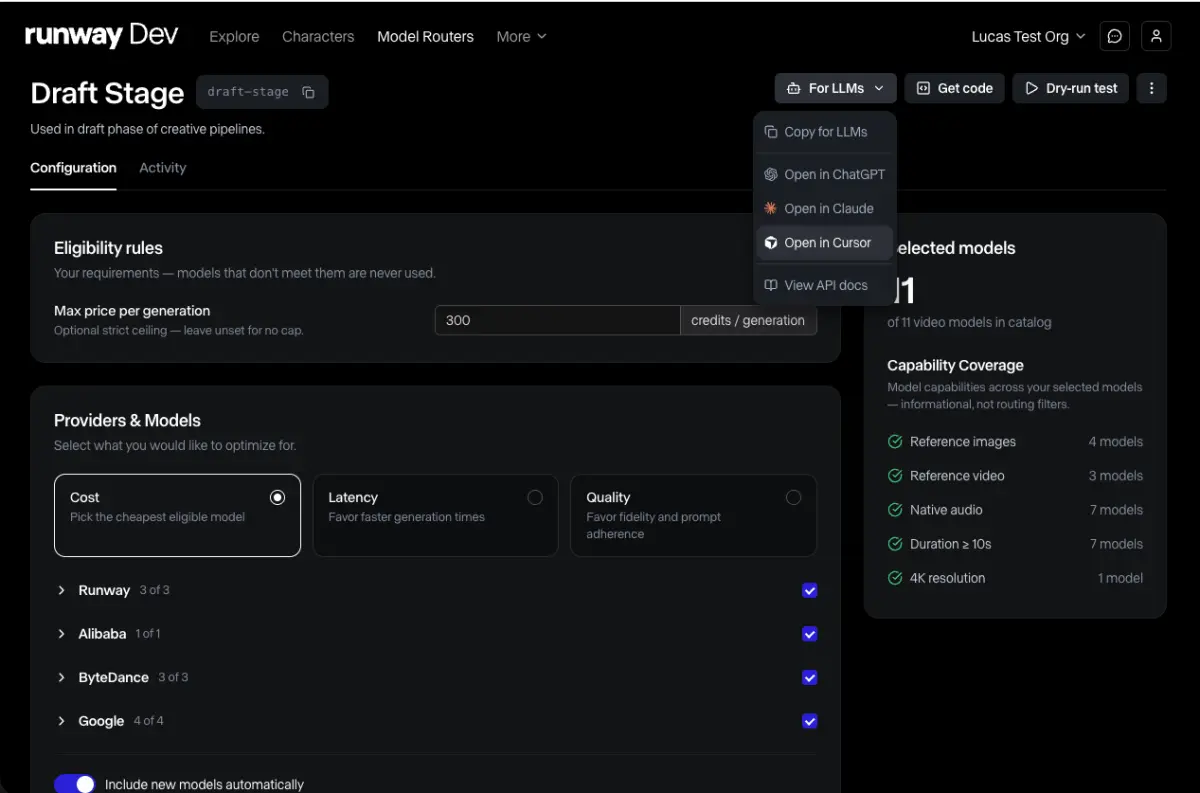
- Runway launched Media Router, which automatically selects an image, video, or audio model per request based on a developer's priority: quality, speed, or cost.
- It's the first router built specifically for generative media rather than text LLMs, though the pattern (route by cost and quality) is already common for LLM traffic.
- The launch lands weeks after Runway replaced its unlimited subscription plans with token-based pricing, a change that drew user criticism.
- Runway's own frontier video model hasn't topped the leaderboards since December, so the company is competing on orchestration (which model to call, not which model it owns) instead of on having the single best model.
- The pattern is a signal for any product that resells or orchestrates third-party model access: when you stop being the cheapest or best model yourself, the routing layer and metered pricing become the moat.
What does Runway's Media Router actually do?
It sits inside Runway Dev, Runway's developer platform, and automatically picks which image, video, or audio generation model to call for a given request, prioritizing whatever a developer cares about most: output quality, generation speed, or token cost. Customers building on Runway Dev, including Adobe, Cloudflare, ElevenLabs, Expedia, Shutterstock, and Quora, can now let Runway's routing layer make that model choice instead of hardcoding a single provider.
Why is this launch really a pricing story?
Because it landed weeks after Runway killed its unlimited subscription plans in favor of token-based pricing, a change that reportedly drew criticism from users. Once you're metering usage in tokens, a router that optimizes for cost per request becomes a natural companion product: it's the tool that helps your customers manage the bill you just started sending them.
Why is Runway building a router instead of a better model?
Runway's last frontier video model, Gen 4.5, shipped in December, and the company hasn't led the video-model leaderboards since. Rather than betting everything on out-building Google, ByteDance, and Alibaba's video models, Runway is repositioning as the orchestration layer that picks the best model for you, regardless of who built it. As co-CEO Anastasis Germanidis put it, the 'intelligence layer that comes on top of the pure pixel models' is where Runway sees its edge now.
What's the lesson for a SaaS founder building on someone else's models?
If you're not the cheapest or the best underlying model provider, and most builders aren't, the value you can defensibly sell is the layer that picks the right model for the job and prices it fairly, not the model itself. That almost always means moving from flat or unlimited pricing toward usage-based billing, because you're now paying real, variable costs to upstream providers on every request your router makes. Model that transition (unlimited to metered, single-model to multi-model) before you commit to it, since the backlash Runway got is a real cost of the move too.
When you can't win on having the best model, the router and the usage-based pricing that funds it can become the product, and that shift is worth modeling in Calcaas before you ship it.
Frequently asked questions
What is Runway's Media Router?
A tool inside Runway Dev that automatically selects the best image, video, or audio generation model for a request, based on whether a developer prioritizes quality, speed, or cost.
Why did Runway move to token-based pricing?
Runway replaced its unlimited subscription plans with token-based pricing weeks before launching the router, a shift toward usage-based billing that mirrors a broader 2026 trend of enterprises managing rising AI token bills.
Is Runway still building its own frontier models?
Yes, but its last leading video model release was Gen 4.5 in December. The company is now also positioning itself as an orchestration layer across third-party models, not solely as a model vendor.
Why does a model router usually require usage-based pricing?
Because the router is now paying variable, per-request costs to whichever upstream model it calls, so a flat or unlimited price becomes harder to sustain profitably as usage grows. (Place the JSON-LD block above inside a <script type="application/ld+json"> tag in the page head.)
More from the blog
 Pricing Strategy
Consumer AI Economics: Why a Huge User Base May Never Break Even
Consumer AI economics hit a ceiling: per a16z and PNC data, 2.2 percent of consumers paid for AI as of May, at about $31 a month. In an illustrative 1M-user app, that is $682k of revenue against about $709k of serving cost, a monthly loss of $27k.
 Pricing Strategy
ChatGPT Pro Max Price: The $500 Plan Is a Pricing Lesson
ChatGPT Pro Max is reportedly a $500-per-month plan, about 25 times a typical $20 plan, with the justification still unclear. For a power user costing $150 a month in tokens, a $20 plan loses $130, a $200 plan earns a 25 percent margin and a $500 plan earns 70 percent.
 Pricing Strategy
Why Hasn't SaaS Pricing Raced to the Bottom? The Uncomfortable Answer for Founders
It's not because competition is weak, it's because price is rarely the thing customers are actually optimizing for, and founders who compete on price alone usually lose anyway.
Pricing math, in your inbox.
One short note a week on AI pricing, token economics, and margin. No spam, unsubscribe anytime.