Claude Opus 5 vs Fable 5: What the Half-Price Flagship Means for Your LLM Cost Model
Anthropic's Claude Opus 5 lands within a few benchmark points of Fable 5 at roughly half the price, and independent testing shows a 20% lower cost per task, a shift worth rerunning your margin math over.
Key takeaways
- Anthropic released Claude Opus 5, benchmarking close to Claude Fable 5: Epoch's Capability Index puts Opus 5 at 159 vs Fable 5's 161, with SWE-ECI tied at 161, while Opus 5 is priced at roughly half.
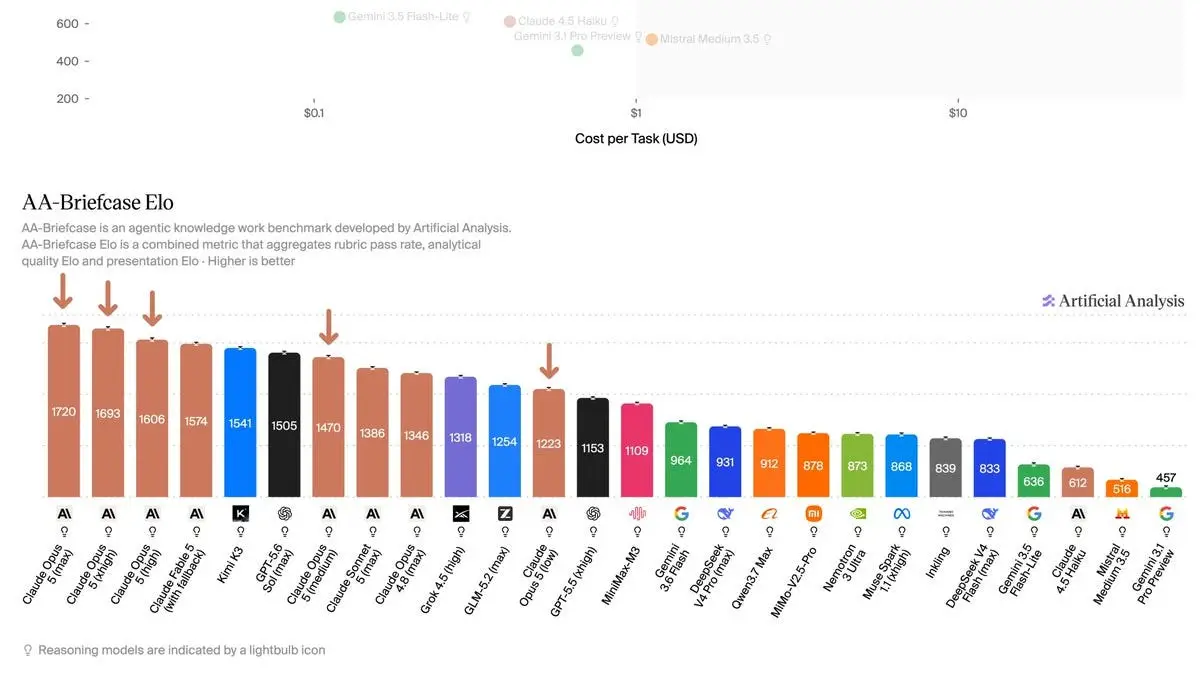
- Artificial Analysis independently found Opus 5 outperforming Fable 5 on its agentic benchmark by nearly 150 Elo while cutting cost per task by 20%.
- The gap between a vendor's flagship and value tier is narrowing, which changes how you should weigh quality against price when picking a default model.
- Benchmarks disagree on how big the capability gap actually is: several practitioners report Opus 5 outperforming Fable in day-to-day coding and agentic tasks despite near-identical aggregate scores.
- For any product billing by usage or token volume, a near-parity model at a lower price point directly moves your blended COGS and margin, model this before you switch defaults.
Why does Opus 5 matter for anyone modeling LLM costs?
Because it collapses the usual trade-off between cheap-and-good-enough and best-available. For a while, the pattern across vendors was a real price premium for the top-tier model over the next tier down. Opus 5 encroaches on Fable-level quality while carrying a meaningfully lower price, the headline claim from coverage is "half Fable." Independent benchmarks from Epoch and Artificial Analysis back this up.
How close is Opus 5 to Fable 5 in practice?
Epoch's Capability Index puts Opus 5 at 159 versus Fable 5's 161 overall, tied at 161 on the software-engineering-specific SWE-ECI. Artificial Analysis went further, saying Opus 5 leads its agentic knowledge-work benchmark (AA-Briefcase) by nearly 150 Elo over Fable 5, while cutting cost per task by roughly 20%. Practitioners on X report a clear head-to-head win for coding work, especially with best-of-n sampling. The aggregate score compresses genuinely different real-world experiences into one number, so read the benchmark, but weigh your own use case too.
What does half the price actually change in your margin math?
If your product passes model costs through to users, directly or as COGS baked into a subscription price, a same-quality-but-cheaper model swap is one of the highest-leverage margin moves available, often more impactful than a pricing-page change. Say, for example, your current blended cost per request assumes Fable-tier pricing: swapping the default model to Opus 5 for comparable output quality could roughly halve that line item without touching what you charge customers. That is margin recovered for free. The catch is that some share of your requests may still need Fable-level quality and some may not, so segmenting by task complexity and routing accordingly usually beats a blanket swap.
Should you switch your default model today?
Not blindly. The benchmark disagreement here, whether Opus 5 is really just below Fable or effectively equal for your workload, is exactly the kind of decision that benefits from running your own numbers instead of trusting a headline. Model both scenarios, current default versus Opus 5 as default, across your actual usage mix, before committing.
A near-parity model at roughly half the price is a live margin lever, model it against your real usage mix before you default to it. You can run that comparison directly in Calcaas.
Frequently asked questions
Is Claude Opus 5 actually better than Fable 5?
It depends on the benchmark. Epoch's aggregate score has Opus 5 slightly behind Fable 5 (159 vs 161) but tied on software engineering (161 vs 161). Artificial Analysis found Opus 5 ahead on its agentic benchmark. Anecdotal reports from coding-focused users often favor Opus 5, especially with best-of-n sampling.
How much cheaper is Opus 5 than Fable 5?
Coverage describes Opus 5 as priced at roughly half of Fable 5's rate, with Artificial Analysis separately reporting a 20% lower cost per task in its agentic benchmark. Exact per-token rates vary by tier (standard, fast, batch), so check current pricing before modeling.
Does a cheaper flagship model always mean better margins?
Only if the cheaper model's output quality is acceptable for your use case. A price cut that increases retries, escalations, or churn can erase the savings. Model both cost and downstream quality impact.
How do I decide whether to switch my product's default model?
Segment your usage by task type, run your actual volume and prompt patterns against both models' current pricing, and compare blended cost per request alongside output quality on a sample of your real tasks, not just public benchmarks.
Where can I model this for my own product?
Plug your usage mix and current provider pricing into Calcaas to simulate the margin impact of a model switch before you commit. Place the JSON-LD block above inside a `<script type="application/ld+json">` tag in the page head.
More from the blog
 LLM Economics
Replit Anthropic Split: The LLM Cost Lesson for Founders
Replit's CEO says the company stopped working with Anthropic over cost, partnership and performance, though people familiar with the partnership dispute that account. The lesson does not depend on who is right: switch LLM providers based on cost per finished task measured on your own workload, not on per-token list prices or headlines.
 LLM Economics
LLM PDF Processing Cost: What 89,000 Documents Really Cost
LLM PDF processing cost can be extremely low: one builder reported a $0.77 total API bill for a project that read 89,000 planning decisions. But that bill hides the real costs: local hardware, a roughly 20 hour full re-read, and engineering time. Price per finished document, not per token.
 LLM Economics
Jevons Paradox in AI: Why Cheaper Tokens Mean Bigger Bills
Jevons paradox in AI means that when tokens get cheaper, people use so many more that total spend rises. If price per task halves from $0.10 to $0.05, volume must double just to hold spend flat, and a tripling lifts spend 50 percent.
Pricing math, in your inbox.
One short note a week on AI pricing, token economics, and margin. No spam, unsubscribe anytime.