The AI Cost Crisis Is Self-Inflicted: How to Control LLM Spend Without Killing Adoption
Most runaway AI bills come from panic-driven defaults rather than workload needs, and a five-step governance framework can pull spend back without slowing adoption.
Key takeaways
- Pylon, a 150-person B2B support platform, saw its Anthropic bill set to jump from $400K to $1.4M per year, triggered by crossing 150 seats into an enterprise tier where every token bills at standard API rates.
- Fable 5 lists at $10 per 1M input tokens and $50 per 1M output tokens, and is estimated at 3-5x the cost of Opus 4.8 and around 10x Sonnet 4.6 on a per-task basis.
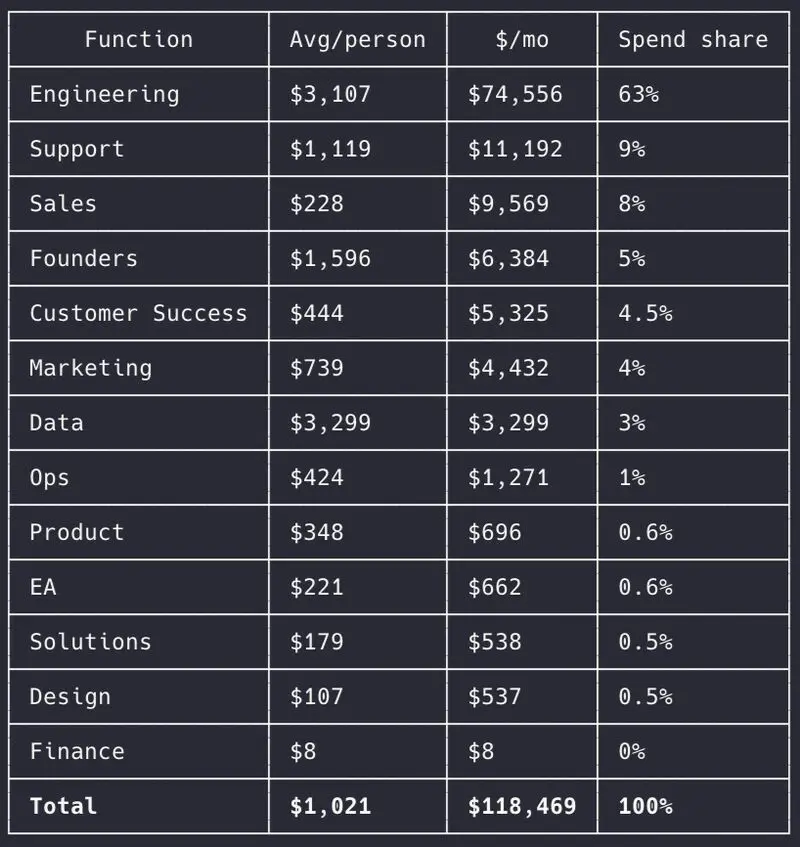
- Inside Pylon: engineering spent $3,107 per person per month on Claude alone, support ran over $11,000 per month for a 10-person team, and one closed-lost analysis burned $4,000 in a few days.
- The crisis is a governance gap, not a technology tax. Kyle Poyar's framework runs from spend visibility to token budgets to zero-based budgeting.
- Your product's AI features obey the same physics: the default model your code calls is a gross margin decision.
Why call the AI cost crisis self-inflicted?
Because the industry built it. Investors panicked, founders pushed AI adoption over everything, and employees defaulted to premium models so nobody could accuse them of falling behind. Kyle Poyar's argument in Growth Unhinged is blunt: nobody chose these costs, everyone defaulted into them.
The bill arrives anyway. Pylon co-founder Marty Kausas went viral for sharing that their Anthropic bill would jump 3.5x overnight, from $400K to $1.4M per year, at a 150-employee company, and only for internal AI use. The trigger was not usage growth. Passing 150 seats pushed them into an enterprise tier where, according to Kausas, usage subsidies disappear and every token bills at standard API rates.
And the newest frontier models raise the ceiling. Fable 5's sticker is $10 / $50 per 1M tokens, about twice Opus 4.8, and because it produces longer responses on the same prompts, its estimated cost per task lands at 3-5x Opus 4.8 and roughly 10x Sonnet 4.6.
What does uncontrolled AI spend actually look like?
When Pylon finally tracked spend by team, the shape was uneven:
- Engineering: $3,107 per person per month on Claude alone, an estimated $5,000 once Codex, Cursor and Devin are counted. Still judged worth it.
- Support: over $11,000 per month across 10 people, with a $2 base inference cost per ticket for automatic investigations.
- Sales: nearly $10,000 per month with modest results.
- Marketing: $739 per person, for copy the CEO himself called terrible.
Same company, same models, wildly different ROI. That spread is the whole argument for governance: some of this spend is the best money the company spends, and some of it is pure default.
How do you cut AI costs without killing adoption?
Start with defaults and routing. Vanta's CFO found Opus 4.7 was priced like Opus 4.6 per million tokens but consumed far more tokens per task, so they set Sonnet 4.6 as the everyday default and blocked Fable outright. Coinbase now defaults to open weight models. Model routers like OpenRouter or LiteLLM send each request to the cheapest capable model. Anthropic's Batch API runs at half price for non-urgent work. Hard caps exist in the wild too: Tesla limits AI spend to $200 per week, Uber to $1,500 per employee per tool per month.
Then run Poyar's five steps: show every person their own spend, decide which spend is actually justified, set token budgets per team with a manager-approval escape hatch, let purpose-built tools compete for that budget, and treat AI like any other investment with owners and expected returns.
The detail worth stealing: budgets are not there to block usage. They add a small amount of friction, which is roughly the amount of thought most AI calls never got.
What do founders miss about their own products?
Here is the observation the internal-spend debate keeps skipping: everything above also describes your COGS. If you sell AI features, the model your code defaults to is a pricing decision your customers never see. An engineer flipping one workflow from Sonnet to a frontier model can move your gross margin more than most pricing committee decisions do, and it ships without a meeting.
So give your product the same treatment Pylon gave its teams: a per-feature token budget, a default model chosen on measured quality per dollar, and an explicit margin target per pricing tier. You can simulate exactly this in Calcaas: per-tier token budgets, provider mixes, and the margin each combination leaves you.
Control the defaults and the crisis mostly dissolves. It was never really about the price of tokens.
Frequently asked questions
Why did Pylon's Anthropic bill jump 3.5x overnight?
Pylon was about to cross 150 seats, which moves customers into Anthropic's Enterprise tier according to its CEO. Enterprise seats no longer include subsidized usage, so every token bills at standard API rates.
How much more expensive is Fable 5?
Fable 5 lists at $10 per 1M input tokens and $50 per 1M output tokens, roughly twice Opus 4.8's sticker price. Because it produces longer responses, estimates put it at 3-5x Opus 4.8 and about 10x Sonnet 4.6 on a cost per task basis.
Do token budgets hurt AI adoption?
Used well, no. Caps with a manager-approval workaround add a small amount of friction rather than removing access, which pushes teams to route routine work to cheaper models while keeping frontier models available where they earn their cost.
What is the first step to controlling AI costs?
Visibility. Track spend at the individual and team level before setting any policy. Pylon found order-of-magnitude differences in ROI between teams, and budgets only make sense against that map. Note: place this JSON-LD in a <script type="application/ld+json"> tag in the page head.
More from the blog
 Founder Guides
How to Cut Agent Token Spend by 80% Without Changing Models
A practitioner reports cutting token spend on dynamic agent workflows by roughly 80% through prompt and workflow restructuring alone, which points at an uncomfortable truth: most agent spend is not on the task, it is on context you resend by default.
 Founder Guides
Log-Scale Pricing Charts Are Quietly Wrecking Your Model Choice
The intelligence-versus-cost chart everyone quotes uses a logarithmic price axis, which compresses a 50x difference into a couple of centimetres and makes wildly different bills look like neighbours.
 Founder Guides
I Modeled What $20,000 a Month on Devin Actually Buys a Solo Founder
A solo founder's public breakdown of spending $20,000 in a month on the Devin coding agent is a useful stress test for how any founder should think about AI-agent ROI, not just whether the number sounds high.
Pricing math, in your inbox.
One short note a week on AI pricing, token economics, and margin. No spam, unsubscribe anytime.